
Lesson 7 of 9 · 25m
Catastrophic Backtracking and ReDoS
The pattern shapes that turn a regex into a denial-of-service, the real outages they caused, and the fixes in order of preference.
On July 2, 2019, Cloudflare deployed a new WAF rule and CPU usage on every edge machine serving HTTP went to 100%. Global traffic dropped for about 27 minutes. The culprit was a regex containing .*(?:.*=.*). Three years earlier, on July 20, 2016, Stack Overflow was down for 34 minutes because a whitespace-trimming regex, ^[\s\u200c]+|[\s\u200c]+$, met a post containing roughly 20,000 consecutive whitespace characters. Neither pattern looks dangerous. That's the point.
Why it blows up
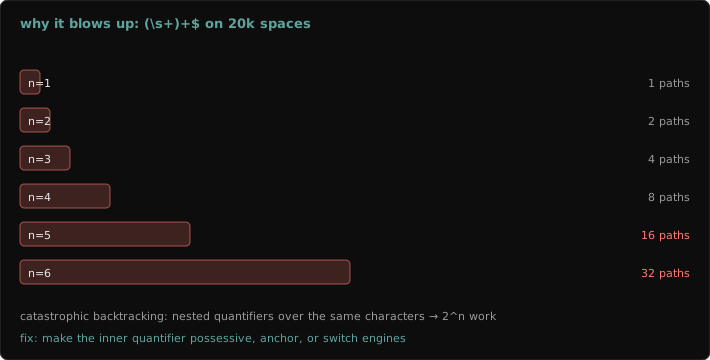
Take ^(a+)+$ against aaaaaaaaaaaaaaaaaaaaaa!. The $ can never match, so the engine must prove failure by trying every way to split the run of as between the inner + and the outer +. There are 2^(n-1) splits. Each extra character doubles the work:
const evil = /^(a+)+$/;
for (const n of [16, 18, 20, 22, 24]) {
  const input = "a".repeat(n) + "!";
  const t0 = performance.now();
  evil.test(input);
  console.log(n, (performance.now() - t0).toFixed(1) + " ms");
}
// each +2 characters is roughly 4x slower; ~30 characters is seconds, ~40 is "page the on-call"The three shapes that cause it
- Nested quantifiers:
(a+)+,(\w+\s?)*,(\d+)*$. Exponential. - Overlapping alternation under a quantifier:
(\w|\d)+,(a|ab)*c,(\s|\S)*. Exponential. - Adjacent quantifiers over the same characters:
.*.*=.*,\s*\s+$,\d+\d+x. Polynomial: quadratic, cubic, worse with each extra term.
The Stack Overflow case was shape 3 combined with an unanchored search: for each of the 20,000 starting positions, \s+$ scanned to the end of the whitespace run and failed on the next character. That's n²/2, about 200 million steps, for one string.
Fixes, in order of preference
- Remove the ambiguity.
^(a+)+$becomes^a+$, and(\w+\s?)*becomes\w+(?:\s\w+)*. When only one path can match each character, there's nothing to backtrack through. - Bound the input. Reject anything over a sane length before the regex sees it. A 4 KB cap turns "exponential" into "annoying."
- Atomic groups and possessive quantifiers, where supported:
(?>\w+),\w++in PCRE, Java, Python 3.11+. - Use a linear-time engine for untrusted input. RE2 (
re2on npm,google-re2on PyPI), Go, Rustregex. Cloudflare's post-mortem committed to exactly this. - Timeouts as a backstop. .NET supports
new Regex(pattern, options, TimeSpan.FromMilliseconds(100)). Node and Python have no per-regex timeout, so isolate risky matching in a worker you can kill.
Stack Overflow's actual fix was the best kind: they replaced the regex with a plain trim function. str.trimEnd() cannot backtrack.
Find them before attackers do
eslint-plugin-regexpwithregexp/no-super-linear-backtrackingflags risky shapes in review.- CodeQL ships
js/redosandjs/polynomial-redosqueries. Run them in CI. recheckanalyzes a pattern and generates an attack string for it.- Fuzz with near-misses: a long run of the repeated character followed by one that forces failure.
Field notes
- The attack input is always a near-miss. Matching inputs are fast. Almost-matching inputs are where the time goes.
- A user-supplied regex (search filters, "custom alert rules") is untrusted code. Run it on RE2 or not at all.
- Compile once.
Pattern.compileinside a Java loop andString.matches(which compiles on every call) are classic hot spots. Python caches recent patterns, but hoist them anyway. - Put failing-input timing tests next to every regex that guards an endpoint.